

The Labubu Origin Story: From Nordic Picture Books to Pop Mart
How Labubu grew from Kasing Lung's childhood reading and picture books into a Pop Mart collectible, with a timeline and notes on conflicting dates.
Labubu looks like an overnight success, but the character has a long back-story. Kasing Lung introduced Labubu in 2015, the year most sources give, as one of The Monsters, a picture-book world inspired by the Nordic elf tales he read as a boy in the Netherlands. Pop Mart describes the character as a small monster with high, pointed ears and serrated teeth. The toys followed the books, first with How2Work and, from 2019, with Pop Mart.
This page tells that story in order, summarises what Lung has said about his choices, and sets out the dates that sources disagree on. It is a fan-written summary drawn from public sources. kasingleung.com is unofficial and is not affiliated with Kasing Lung, How2Work or Pop Mart. For the person himself, see the artist biography; for the character, see the Labubu guide.
A childhood among elf stories
Kasing Lung was born in Hong Kong in 1972 and moved to the Netherlands in 1978. Wikipedia says he struggled with Dutch at first, and that a teacher pointed him towards illustrated books for young readers, especially ones on Nordic folklore and mythology.
His home had no game consoles or computers, so he read, drew and was drawn to old European elf legends, as The Art Gorgeous reports from his remarks to Hypebeast. Wikipedia names Nordic myth as the source for Labubu, while The Art Gorgeous mentions Celtic folklore and a small creature that brings both luck and mischief. The two descriptions overlap more than they clash.

Illustrator first
After art school he graduated in 1995 and returned to Hong Kong, working as an illustrator with Culturecom until 2003. Following the SARS epidemic he moved to Belgium, where he made films and illustrated books with the publisher De Eenhoorn. Wikipedia notes that he became the first Chinese winner of Belgium’s Illustration Award, for “Mama is Weg”.
The toy years with How2Work
From 2010 Lung shifted from illustration towards toy design. His first project with the art-toy brand How2Work was a finger-puppet series, “a Toys foresT”, paired with illustrated storybooks. Sales were slow for about three years, and Wikipedia says encouragement from his wife, colleagues and How2Work’s founder Howard Lee kept him going.
Why Lung created The Monsters
In a May 2025 interview with Perfect magazine, Lung said The Monsters followed an earlier series, Toy Forest, and that he wanted a present-day fantasy world that would make many people happy. He credited The Smurfs, watched as a child, for his wish to build a large cast.
NPR, citing his March 2025 interview with CGTN Europe, quotes him as saying he wanted “to create something that I’ve always known existed in my heart”. NPR also reports that, according to Lung, there are about 100 different Labubus in the series.
His order of work is sketches first, then illustrated books, then toys and merchandise.
The Monsters on the page
The elves appeared in picture books published by How2Work: The Story of Puca (2015), Pato and the Girl (2016) and Milo’s Requiem (2017). Pop Mart’s own description says Lung created the fairy world “in three picture books inspired by Nordic mythology” in 2015, with characters “both good and evil”. The Monsters Wiki says the series debuted in 2015 and that How2Work made figurines before Pop Mart arrived. The books, and which of them Labubu comes from, are covered on the works page.
Labubu was not planned as the star. Lung has said every character in The Monsters is meant to be a lead, and that Labubu was simply the first, followed by Tycoco, Yaya, Zimomo, Pato and others.
Where the name comes from
The name has no hidden meaning. BBC News reported in June 2025 that “the word itself doesn’t mean anything”. Lung told Perfect he chooses distinctive names so that an online search finds his character instead of a crowd of ordinary names.
How the design changed
From the start Labubu had the features that still define her: tall pointed ears and a mouthful of teeth. Lung has said the teeth were meant to set his characters apart from others on the market, and BBC News counts exactly nine. For a source-by-source comparison refuting the 2024–2025 viral claim that the nine-tooth grin or name came from the Mesopotamian demon Pazuzu, see our Nordic elf folklore vs. Pazuzu myth fact-check.
What changed most was the object. How2Work made the first Monsters figurines; under Pop Mart, from 2019, the character moved into plush. Wikipedia dates the first Labubu key-ring line, Exciting Macaron, to October 2023. Wikipedia’s article on Lung links to an image it labels as a redesigned Labubu from 2019. No source cited here describes what was redesigned. Treat a redesign claim as unconfirmed until a source describes the change.
From Taiwan and Hong Kong to Pop Mart
Wikipedia reports that Labubu did well in Taiwan and that Lung began selling in Hong Kong from 2017. In 2019 he signed an exclusive licensing agreement with Pop Mart, which has since produced and distributed the characters as collectibles. More than 300 versions and collections have followed.
In 2024, Labubu went viral among collectors after Lisa of BLACKPINK showed hers on social media. A year later, 2025, was marked as the character’s 10th anniversary.
Timeline
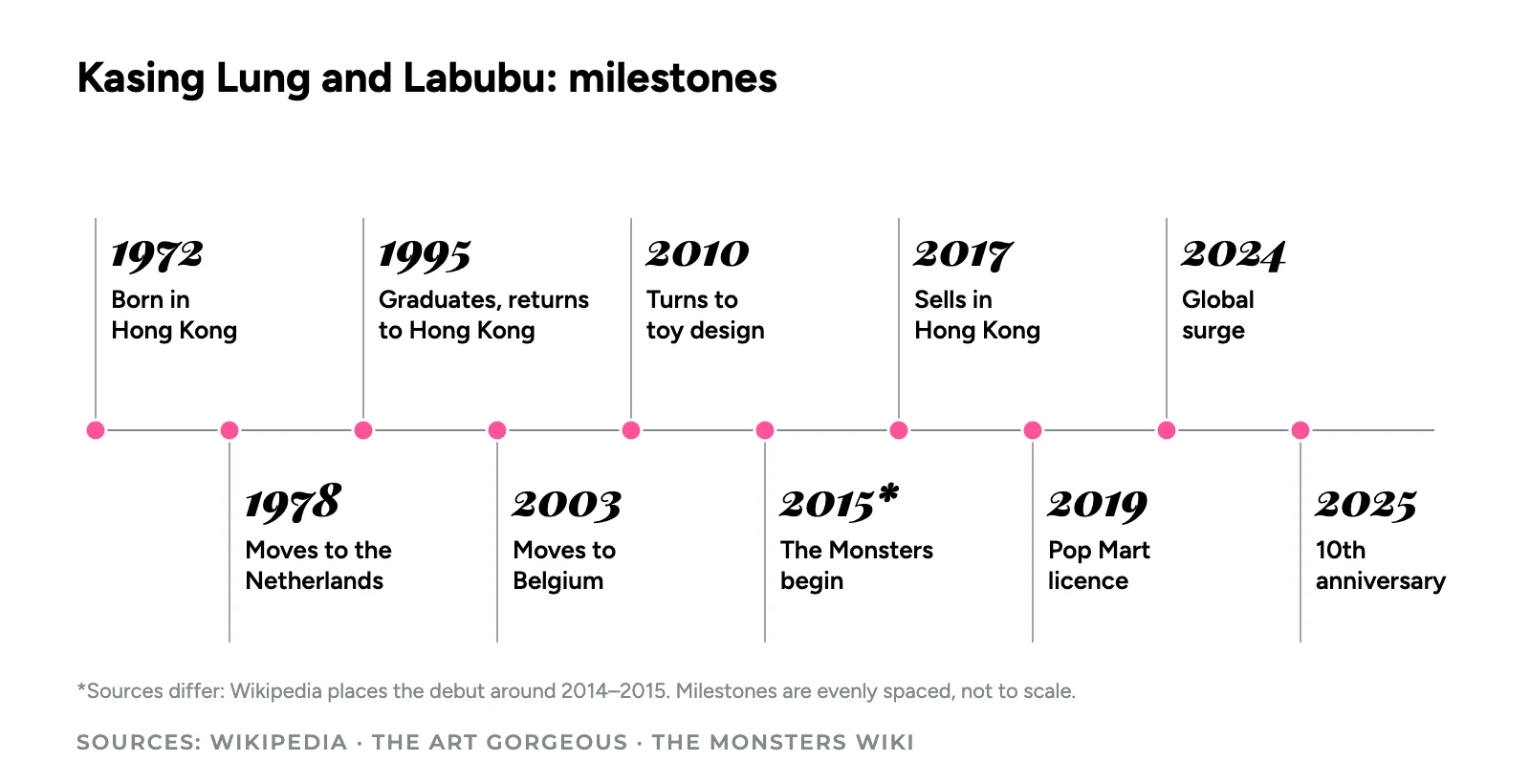
Scroll horizontally if columns extend beyond the table.
| Year | Milestone |
|---|---|
| 1972 | Kasing Lung born in Hong Kong |
| 1978 | Moves to the Netherlands |
| 1995 | Graduates and returns to Hong Kong |
| 2010 | Begins shifting from illustration to toy design (Wikipedia) |
| 2011 | Starts working with How2Work in Hong Kong, per Kaikai Kiki |
| 2015 | The Monsters first appear, per The Monsters Wiki and The Art Gorgeous |
| 2016 | Pato and the Girl published |
| 2017 | Milo’s Requiem published; Lung begins selling in Hong Kong |
| 2019 | Exclusive licensing agreement with Pop Mart |
| 2023 | Exciting Macaron, the first Labubu key-ring line, released in October (Wikipedia) |
| 2024 | Labubu goes viral among collectors after Lisa’s posts in April |
| 2025 | Marked as Labubu’s 10th anniversary |
Conflicting dates
Sources do not agree on every detail. Here are the main discrepancies.
- 2014 or 2015. The Monsters Wiki and The Art Gorgeous date the first appearance to 2015. Wikipedia places Labubu’s debut around 2014 to 2015.
- The trilogy. Wikipedia lists The Monsters Trilogy as published on March 30, 2019. The Monsters Wiki says the three short books were reprinted as a trilogy in 2021.
- First solo exhibition. The Art Gorgeous calls his 2020 Tokyo show his first solo exhibition, and the wiki also gives 2020 for his first art exhibit. Wikipedia separately lists a solo exhibition, “De Kleuren Monsters”, around 2017.
- Starting with How2Work. Wikipedia dates the How2Work collaboration from 2010 and gives no date for a move back to Hong Kong. Kaikai Kiki says he began working with How2Work in Hong Kong as an illustrator in 2011. The Monsters Wiki says he returned to Hong Kong in 2012 to partner with the brand.
- His age at the move. NPR says he moved to the Netherlands at age 7. Wikipedia gives a birth date of December 31, 1972 and a move in 1978, which would make him five or six.
- First solo exhibition, reconciled in part. Kaikai Kiki, which shows his paintings, calls the 2020 Tokyo show his “first solo art exhibition” but also lists earlier solo shows from 2012 that share names with his books and toys, including “De Kleuren Monsters” in 2017.
We have kept each version attributed rather than choose between them.
Keep reading
- Kasing Lung and the Pop Mart licence: the artist side of the 2019 deal.
- Works: picture books: the books behind the characters.
- When was Labubu created?: the short answer on the debut date.
Sources
- Wikipedia, “Kasing Lung”
- Wikipedia, “Labubu”
- Perfect, “Bryan Yambao in conversation with Kasing Lung, the creative force behind Labubu” (May 8, 2025)
- NPR, “‘Labubu’ is a plush toy that is causing a frenzy. Here’s its origin story” (June 18, 2025)
- BBC News, “Adorable or just weird? How Labubu dolls conquered the world” (June 20, 2025)
- Kaikai Kiki, “Kasing Lung”
- POP MART, “THE MONSTERS”
- The Art Gorgeous, “Kasing Lung: The Artist Behind the Internet’s Favourite Monster, Labubu”
- The Monsters Wiki, “Kasing Lung”
- The Monsters Wiki, “The Monsters”