
Is Labubu Demonic? Nordic Elf Folklore vs. the Pazuzu Myth
Fact-checking the viral Pazuzu demon rumor against Kasing Lung's 2015 Nordic elf picture books, Labubu and Zimomo design notes, and museum records.
Confusing a 2015 Nordic picture-book elf with an Iron Age Mesopotamian wind deity leads to wrong origin claims, damaged collectibles, and misread character records. Addressing the labubu demonic rumor requires comparing Kasing Lung’s documented European fairy-tale books and character notes against the Neo-Assyrian bronze artifacts of the pazuzu demon in the Louvre and the British Museum.
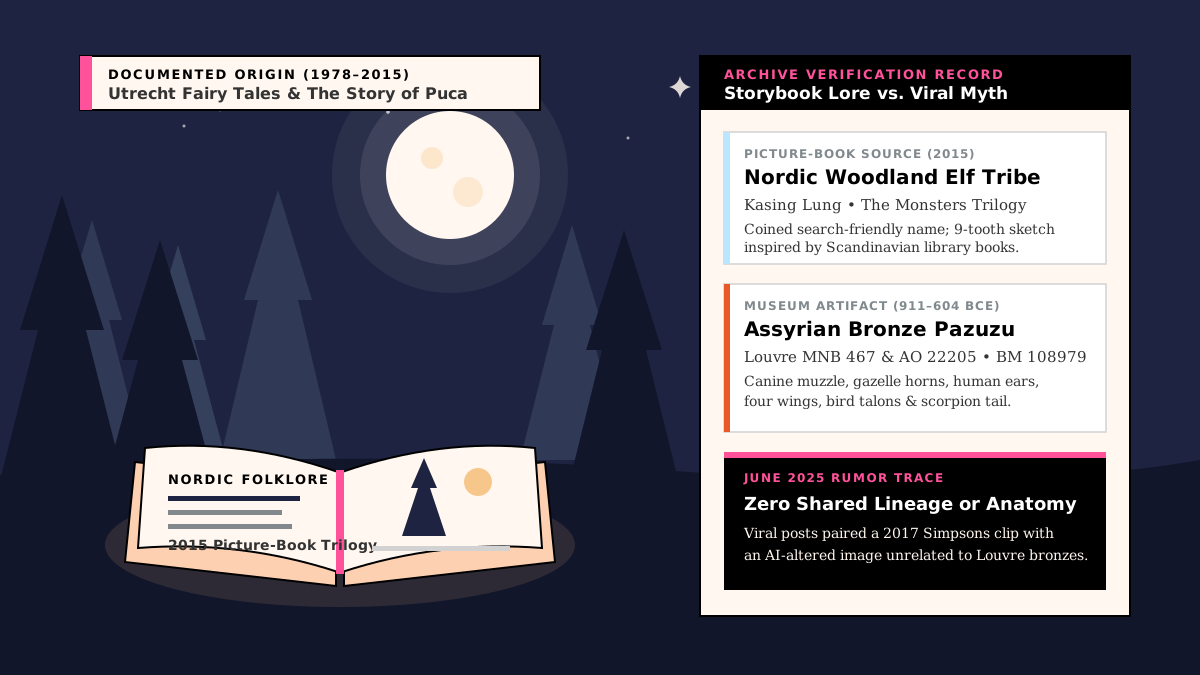
No—Labubu is not demonic and has no historical, linguistic, or visual link to Pazuzu. Hong Kong-born illustrator Kasing Lung created Labubu in 2015 (dated c. 2014–2015 in Wikipedia) for his picture-book trilogy The Monsters, drawing on the Northern European and Scandinavian elf tales he read as a schoolboy in Utrecht, the Netherlands. The viral June 2025 claim linking Labubu to Pazuzu relied on a 2017 Halloween parody clip from The Simpsons (“Treehouse of Horror XXVIII”) paired with an AI-generated illustration altered to give an ancient wind deity rabbit-like ears and a wide grin.
This reference sets out the primary literary, interview, and museum records side by side—including where published sources differ on dates or regional folklore labels—so readers can verify every claim against its original document. kasingleung.com is an independent, unofficial fan guide and is not affiliated with Kasing Lung, How2Work, or Pop Mart. For the broader chronology of the series, see the Labubu origin story; for our source-attribution rules, see how we research.
Labubu vs. Pazuzu at a glance: source-by-source verification
The fastest way to evaluate the social-media rumor is to compare the published design record for Labubu (and tribe leader Zimomo) against the cataloged archaeological features of Neo-Assyrian Pazuzu bronzes from the first millennium BCE.
Scroll horizontally if columns extend beyond the table.
| Verification dimension | Labubu (The Monsters picture-book record) | Pazuzu (1st-millennium BCE museum record) | Dominant failure mode & prevention |
|---|---|---|---|
| Creator, culture & date | Created in 2015 (c. 2014–2015 per Wikipedia) by illustrator Kasing Lung (b. 1972) for his picture books with How2Work, later licensed to POP MART in 2019 | Neo-Assyrian and Babylonian religion, first half of the 1st millennium BCE (911–604 BCE on Louvre MNB 467 and AO 22205) in ancient Mesopotamia |
Treating a modern art-toy character as an ancient deity; prevent by checking the 2,800-year chronological gap (Time span = 2015 - (-911) = 2,926 years). |
| Name etymology | Coined by Kasing Lung with no literal meaning (BBC News); chosen so Google searches return his character rather than common names like “Johnny” (Perfect Magazine) | Akkadian pà.zu.zu, inscribed in Neo-Assyrian syllabic cuneiform across the wings of Louvre MNB 467 as “Pazuzu, son of Hanpa, king of the evil wind-spirits (lilû)” |
Assuming phonetic similarity implies shared etymology; prevent by checking the artist’s May 2025 Perfect Magazine naming interview. |
| Literary & cultural inspiration | Northern European, Scandinavian, and Nordic fairy tales read in Dutch school libraries in Utrecht (CGTN Europe / NPR, POP MART, Joint Publishing); Celtic folklore also cited by The Art Gorgeous | Mesopotamian personification of the destructive southwestern storm wind, invoked on domestic bronze and stone amulets to drive away the demoness Lamashtu (Louvre AO 22205) |
Conflating European woodland trickster elves with Near Eastern exorcism plaques; prevent by keeping literary influences attached to their named interviews. |
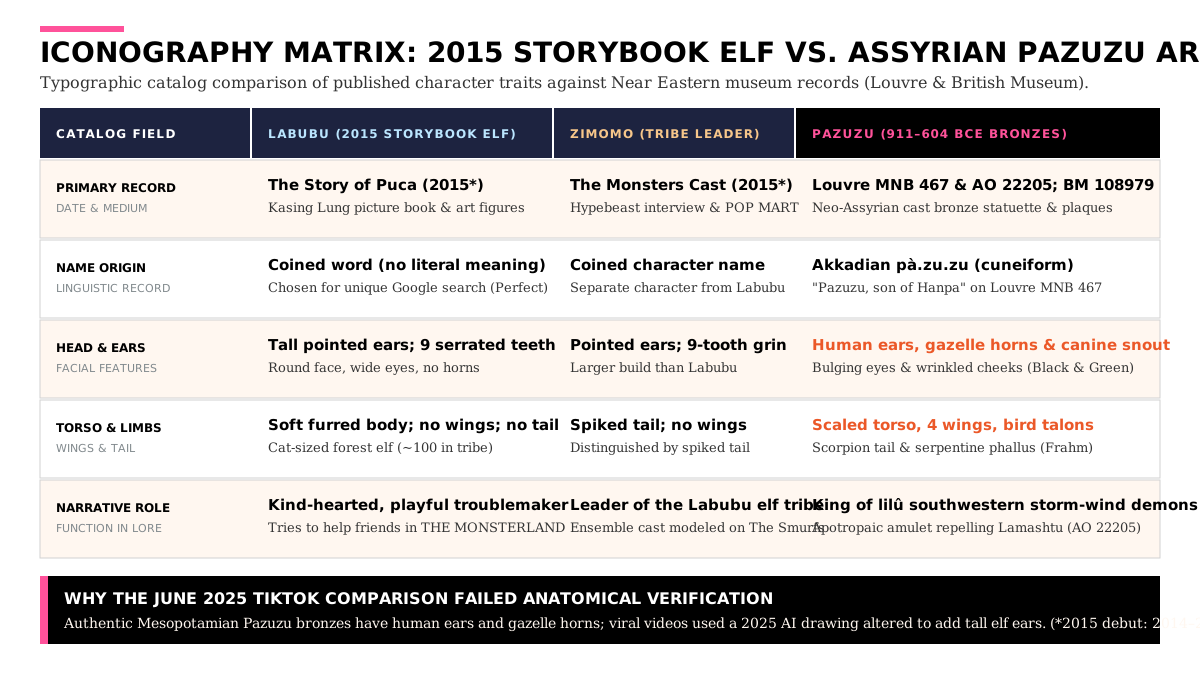
| Head, ears & facial anatomy | Round face, tall upright pointed elf ears, wide eyes, no horns, and a mischievous smile displaying exactly 9 serrated teeth (POP MART, BBC News, Wikipedia) | Canine or leonine muzzle, abnormally bulging eyes, wrinkled cheeks, human ears, and gazelle horns (Louvre MNB 467, British Museum BM 108979, Black & Green 1992) |
Accepting viral side-by-side TikTok graphics at face value; prevent by verifying that authentic Pazuzu bronzes have human ears and horns rather than elf ears. |
| Body, limbs, wings & tail | Plump, cat-sized furry body, two arms, two legs, no wings, and no tail (only tribe leader Zimomo has a spiked tail) | Scaled canine torso, four feathered wings (two pairs), bird-of-prey talons for feet, scorpion tail, and serpentine phallus (Louvre MNB 467, Frahm / Wiggermann) |
Mistaking AI-generated artwork for museum photography; prevent by checking Louvre Richelieu Wing Room 230 catalog entries. |
| Narrative role & function | Kind-hearted, curious, playful forest elf whose eagerness to help friends in THE MONSTERLAND often causes accidental mischief (POP MART, BBC News) |
Apotropaic counter-demon hung in homes or worn by pregnant women to repel Lamashtu; popularized in modern horror by The Exorcist (1973) and parodied in The Simpsons (2017) | Reading a 2017 animated horror parody as toy history; prevent by tracing viral clips back to The Simpsons Season 29, Episode 4. |
What is the documented Labubu Nordic folklore origin?
The labubu nordic folklore origin traces directly to Kasing Lung’s childhood language education in the Netherlands and his two decades as a European picture-book illustrator before the character ever became a vinyl-plush bag charm.
From Yuen Long to Utrecht school libraries
Kasing Lung (born December 31, 1972 in Hong Kong, with family roots in Yuen Long) spent his earliest school years living with his grandparents in Yuen Long and attending Chung Sing School until Primary 2 before moving to Utrecht, the Netherlands, where his parents worked in Chinese catering. Published biographies differ slightly on his exact age at the move: Wikipedia dates the relocation to 1978, which places him at age five or six, whereas NPR and Snopes—both quoting Lung’s March 2025 interview with CGTN Europe—report that he moved to the Netherlands at age seven. Speaking to Perfect Magazine in May 2025, Lung recalled living upstairs from his parents’ restaurant in a small Dutch village and drawing every day after school. You can follow those early biographical milestones in our Kasing Lung biography.
Because he did not speak Dutch when he entered primary school, his teacher gave him illustrated children’s books to accelerate his reading. In his March 2025 CGTN Europe interview (quoted by Snopes and NPR), Lung explained how those Dutch library books shaped his visual world:
“I also remember reading many fairy tales from Northern Europe and Scandinavia. I spent a lot of time reading in the library to improve my Dutch… So I’ve always come up with something related to the fairy tales and what I loved so much when I was a kid.”
In a separate interview with Hypebeast (reported by The Art Gorgeous), Lung added that his childhood home had no video game consoles or computers, leaving him to read ancient European elf legends and draw characters with a ballpoint pen.
Antwerp picture books, How2Work, and the 2015 Monsters trilogy
After graduating from art school in 1995 and working as an illustrator at Culturecom in Hong Kong until the 2003 SARS outbreak, Lung moved to Belgium. Working with the Belgian children’s publisher De Eenhoorn, he became the first Chinese winner of Belgium’s Illustration Award / European Picture Book Competition (Wikipedia credits Mama is Weg; Joint Publishing Hong Kong’s author biography names his 2003 work Oki). Between 2010 (per Wikipedia) and 2011 (per Kaikai Kiki, POP MART, and Joint Publishing), he partnered with Howard Lee of the Hong Kong art-toy house How2Work on the storybook and finger-puppet series a Toys foresT (Toy Forest).
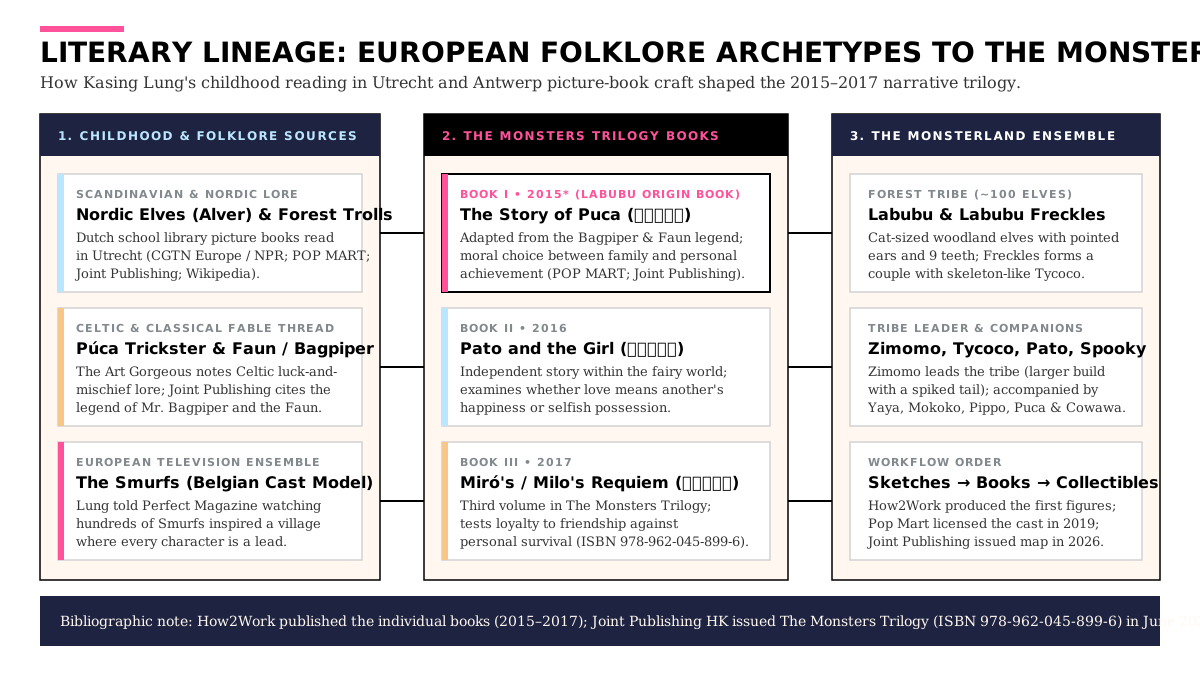
Following Toy Forest, Lung introduced The Monsters in three picture books first published with How2Work between 2015 and 2017 and later collected in Traditional Chinese by Joint Publishing Hong Kong (精靈三部曲 THE MONSTERS TRILOGY, ISBN 978-962-045-899-6, published June 18, 2026 with a foldout map of THE MONSTERLAND):
- The Story of Puca (《神秘的布卡》, 2015): Identified in POP MART’s official character introduction as the picture book from which Labubu originates. Joint Publishing’s bibliographic synopsis notes that the story adapts the European legend of Mr. Bagpiper and the Faun (風笛先生和羊男的傳說故事) to explore the moral choice between family affection and personal achievement.
- Pato and the Girl (《柏度與少女》, 2016): An independent narrative in the same fairy world examining whether love prioritizes another person’s happiness or selfish possession.
- Miró’s Requiem / Milo’s Requiem (《米羅安魂曲》, 2017): The closing volume of the trilogy, testing loyalty to friendship against personal survival.
For edition notes and how the picture books relate to later figure lines, see which book Labubu comes from.
Why some sources say “Nordic” and others say “Celtic”
Readers checking multiple articles will notice two regional labels for the folklore behind The Monsters:
- Nordic and Scandinavian folklore: POP MART’s official IP introduction, Joint Publishing Hong Kong’s trilogy record, Wikipedia, BBC News, Snopes, and NPR (quoting Lung’s CGTN Europe interview) all attribute The Monsters to Nordic or Scandinavian mythology and elf tales (alver and forest trolls).
- Celtic folklore: The Art Gorgeous (May 6, 2025) describes Labubu as a mischievous creature inspired by Celtic folklore who brings both luck and mischief—a phrasing that also echoes Púca, the shape-shifting trickster spirit of Celtic and Irish folklore named in the first book’s title, The Story of Puca.
Both descriptions point to northwestern European woodland fairy tales rather than Near Eastern demonology.
Takeaway: Every documented interview and publisher biography traces The Monsters to European library picture books read in Utrecht and illustrated in Antwerp between 1978 and 2015.
Why does Labubu have 9 serrated teeth, pointed ears, and that name?
The conspiracy theory rests almost entirely on two surface questions: why a children’s picture-book elf has a mouthful of sharp teeth, and whether the word “Labubu” is a coded variant of “Pazuzu.” Kasing Lung has answered both questions directly in on-the-record interviews.
The 9-tooth grin and The Smurfs village model
In his May 8, 2025 interview with Bryan Yambao for Perfect Magazine, Lung explained that Labubu’s serrated grin was a deliberate graphic-design choice to stand out in the collectible market, while the size of the cast came from watching The Smurfs (created by Belgian cartoonist Peyo) on European television as a child:
“There’s a reason why I created characters with many teeth – to make them unique in the market. After that we released Tycoco because I like skeletons, and then we had many others like Yaya and Zimomo and Pato. When I was young, I used to watch The Smurfs on television – and you know the Smurfs, there are hundreds of them! That’s the reason why I wanted to create a big universe with a lot of monsters.”
According to POP MART’s official character profile, BBC News, and NPR, “Labubu” is both the name of a central female elf and the name of a forest tribe of roughly 100 cat-sized elves living in THE MONSTERLAND. Despite the mischievous, wide-eyed grin showing exactly nine teeth, POP MART and BBC News characterize Labubu as optimistic and kind-hearted—an elf who always wants to help her friends, even when her enthusiasm accidentally causes chaos. Within that tribe, LABUBU FRECKLES forms a playful couple with the shy, skeleton-looking character TYCOCO, while ZIMOMO serves as the male leader of the tribe and is distinguished by a larger build and a spiked tail (see our guide to Labubu, Zimomo, and The Monsters cast and the FAQ on who Zimomo is).
Threshold rule of thumb for collectors: Genuine Labubu character illustrations and official POP MART vinyl faces display Teeth_Count = 9. If a doll presented as Labubu displays Teeth_Count > 9 (such as 10 or 11 uneven teeth) or human-like molar teeth, you are looking either at an unlicensed counterfeit nicknamed “Lafufu” (covered in our real vs. fake Labubu verification guide) or at an unrelated retail toy brand such as Fuggler (covered in our Labubu vs. Fuggler comparison).
Why Kasing Lung coined the name “Labubu”
In June 2025, BBC News noted plainly of the name Labubu: “The word itself doesn’t mean anything.” In his May 2025 Perfect Magazine interview, Lung explained the practical search-engine logic behind coining the word:
“I like to give my characters unique names. I think one of the reasons why people like Labubu is because the name is very catchy. When people type ‘Labubu’ in the search bar on Google, they will show up – it’s very clear. If I named the character ‘Johnny’, there’s going to be a lot of Johnnies coming up on the searches.”
That statement leaves no room for an occult etymology: “Labubu” is a modern, coined string designed for unambiguous online search discovery.
Who was the Pazuzu demon in Mesopotamian archaeology?
To see why art historians and fact-checkers immediately dismissed the viral comparison, it helps to examine what the pazuzu demon actually looks like in first-millennium BCE Assyrian and Babylonian material culture.
Museum catalog records: Louvre MNB 467, Louvre AO 22205, and British Museum BM 108979
In ancient Mesopotamia during the first half of the first millennium BCE (roughly 911–604 BCE, the Neo-Assyrian and Neo-Babylonian periods), Pazuzu (Akkadian pà.zu.zu) was the personification of the destructive southwestern storm wind and king of the evil wind demons (lilû). Three benchmark museum artifacts establish his standardized ancient iconography:
- Musée du Louvre, Inventory No.
MNB 467(Figurine du démon Pazuzu): Displayed in the Richelieu Wing (Room 230, Vitrine 4) and acquired by the Louvre in 1872, this cast bronze statuette from Neo-Assyrian Iraq dates to 911–604 BCE and measures 15.0 cm in height, 8.6 cm in width, and 5.6 cm in thickness (Volume_Envelope = 15.0 × 8.6 × 5.6 = 722.4 cm³). A suspension loop (bélière) sits at the top of the head. Across the back of its four wings runs a syllabic Neo-Assyrian cuneiform inscription translated by the Louvre catalog: “I am Pazuzu, son of Hanpa, king of the evil spirits of the air who comes out violently from the mountains, raging, that is I.” - Musée du Louvre, Inventory No.
AO 22205(Plaque des Enfers / Plaque of Exorcism against Lamashtu): Acquired in 1879 via Aimé Péretié and the Louis De Clercq collection, this cast and incised bronze plaque from Assyria (discovered in Syria, dated 911–604 BCE, measuring 13.8 cm × 8.8 cm × 2.5 cm) illustrates Pazuzu’s domestic apotropaic function. On the reverse, Pazuzu grips the top edge of the bronze plaque so his horned head peers over the top; on the obverse, across four registers, divine emblems, animal-headed protective spirits, and fish-cloaked priests (apkallu) beside a bedridden patient invoke Pazuzu to drive the child-harming demoness Lamashtu (depicted kneeling on a donkey in a boat holding snakes) back to the underworld. - The British Museum, Registration
BM 108979(W_1914-0407-145) and Nimrud Bronze Heads (BM 91875,BM 132964): Copper-alloy and bronze apotropaic amulets from Mesopotamia (c. 900–500 BCE) formed with top suspension loops so pregnant women and mothers could wear them or hang them in bedrooms as protection against Lamashtu.
Standard anatomical features in Near Eastern scholarship
In Gods, Demons and Symbols of Ancient Mesopotamia: An Illustrated Dictionary (British Museum Press, 1992, cited by Snopes) and the iconographic studies of Assyriologists Eckart Frahm and Franz Wiggermann, Pazuzu’s visual form is strictly consistent across bronze, terracotta, stone, and red jasper (Louvre AO 26056) artifacts:
- Head and ears: A rectangular canine or leonine muzzle, abnormally bulging eyes, deeply wrinkled cheeks, human ears set low on the skull, and curving gazelle or caprid horns sweeping back over the crown.
- Torso and limbs: A scaled, emaciated canine torso with exposed ribs, a raised right hand in a striking posture, and bird-of-prey talons in place of feet.
- Wings and tail: Two pairs (four) of feathered wings meeting across the back and an arched scorpion tail (paired with a snake-headed phallus).
Not one authentic Mesopotamian artifact of Pazuzu has tall rabbit-like or elf-like ears, soft fur, a round cherubic face, or a nine-tooth smile.
Takeaway: Authentic first-millennium BCE Pazuzu bronzes (Louvre MNB 467, Louvre AO 22205, BM 108979) feature human ears, gazelle horns, four wings, bird talons, and a scorpion tail—sharing zero anatomical traits with Kasing Lung’s forest elf.
How the 2024–2025 viral TikTok rumor was fabricated
Digital culture archives at Know Your Meme and the formal July 11, 2025 fact-check by Snopes (written by Joey Esposito) allow the labubu demonic panic to be traced through two distinct stages between late October 2024 and July 2025.

Phase 1 (October–November 2024): General “elf monster” panic
When Labubu bag charms surged globally in 2024 (covered in our Labubu character and craze overview), early religious commentary targeted the character’s actual Nordic elf description rather than Mesopotamia:
- October 30, 2024: TikTok user
@cjtecsondavidposted a video (which reached 8.8 million views) warning Christian viewers against buying Labubu dolls and tagging#NordicMythologyand#ElfMonster. - November 1–2, 2024: Exorcist Fr. Carlos Martins discussed the dolls on the Adrian Milag TV podcast (1.4 million Facebook views), followed the next day by a thread on Reddit’s
r/Christian. None of these autumn 2024 posts mentioned Pazuzu.
Phase 2 (May–July 2025): The AI-altered Pazuzu image and the 2017 Simpsons clip
After a run of May and early June 2025 TikTok videos claiming Labubu caused sleep paralysis, showing fans jokingly taking dolls to church for blessings (1.5 million views on May 26, 2025), or calling the doll “Annabelle’s child” (June 12, 2025), the specific Pazuzu narrative launched on June 23, 2025:
- The AI-altered “Pazuzu” drawing (June 23, 2025): Now-deleted TikTok user
@nocoriousposted a comparison video placing a Labubu doll beneath a modern AI-generated illustration labeled “Pazuzu.” Unlike genuine Assyrian bronzes (Louvre MNB 467), the AI image had been generated or prompted to feature tall upright rabbit-like ears and a wide Labubu-style grin. Within hours on June 23, 2025, X user@tartetartine(in a post garnering over 331,000 likes) and museum commenters demonstrated that the viral drawing was AI-fabricated and bore no resemblance to ancient Mesopotamian artifacts. - The 2017 Simpsons episode splice (June 23–July 2025): TikTok user
@dlyclpz(350,000+ views in 24 hours) and subsequent Facebook and Instagram posts stitched the Pazuzu claim together with a clip from The Simpsons Season 29, Episode 4 (“Treehouse of Horror XXVIII,” first broadcast in October 2017). In that episode—a parody of the 1973 horror film The Exorcist, which opened with a statue modeled onLouvre MNB 467—Homer Simpson accidentally orders a Pazuzu statue thinking it is pizza, and the demon possesses baby Maggie Simpson. Viral 2025 captions falsely claimed the 2017 cartoon “predicted Labubu.” - July 2025 fact-checks and regional bans: On July 11, 2025, Snopes published its investigation confirming zero connection between Labubu and Pazuzu. Despite the debunking, Wikipedia documents that authorities in Erbil (in Iraq’s Kurdistan Region) banned Labubu sales and seized more than 4,000 dolls in July 2025 after local media repeated the “demonic spirits” rumor, while members of Russia’s Federation Council (Ekaterina Altabaeva and Tatiana Butskaya) proposed restrictions citing the dolls’ “terrifying appearance” and missing Russian-language packaging labels.
Frequently asked questions
Is Labubu based on the Mesopotamian demon Pazuzu?
No. Labubu was created in 2015 (or c. 2014–2015 per Wikipedia) by Hong Kong-born artist Kasing Lung for his children’s picture-book series The Monsters, inspired by Northern European and Scandinavian elf tales he read as a child in the Netherlands. The June 2025 viral videos claiming a link to Pazuzu relied on an AI-generated drawing altered to look like Labubu rather than genuine Neo-Assyrian Pazuzu bronzes (Louvre MNB 467 and AO 22205), which have human ears, gazelle horns, a canine snout, four wings, bird talons, and a scorpion tail.
Did The Simpsons predict Labubu in a Pazuzu episode?
No. The clip used in viral 2025 TikTok and Facebook posts comes from The Simpsons Season 29, Episode 4 (“Treehouse of Horror XXVIII”), which aired in October 2017 as a parody of the 1973 film The Exorcist. In that segment, Homer orders an ancient Pazuzu statue that possesses Maggie Simpson; the episode neither depicts nor mentions Labubu, which Kasing Lung had already published in picture books in 2015.
What does the word “Labubu” actually mean?
The word “Labubu” has no literal translation or ancient linguistic root. As BBC News reported in June 2025, the word itself means nothing, and Kasing Lung explained to Perfect Magazine in May 2025 that he coined the catchy, unusual name so that typing “Labubu” into Google would immediately return his character instead of common names like “Johnny.”
Why does Labubu have nine sharp teeth if she is a good character?
Kasing Lung told Perfect Magazine in May 2025 that he drew his characters with many teeth simply “to make them unique in the market.” In POP MART’s official character lore and BBC News coverage, Labubu has exactly nine teeth and is a kind-hearted, optimistic woodland elf who always tries to help her friends, even when her playful energy accidentally causes mischief.
How can you tell Labubu apart from Zimomo in The Monsters lore?
In Kasing Lung’s interviews and POP MART’s official cast descriptions, Labubu is both a central female elf and the name of a forest tribe of roughly 100 cat-sized elves who have pointed ears, nine teeth, and no tail. Zimomo is a separate male character—the leader of the Labubu tribe—whom Lung designed with a larger build and a spiked dinosaur-like tail.
Keep reading
- The Labubu Origin Story: From Nordic Picture Books to Pop Mart: follow the full chronological timeline from Kasing Lung’s 1978 move to Utrecht through the 2019 Pop Mart licensing agreement.
- Kasing Lung: A Biography of the Artist Behind Labubu: see how Lung’s career in Hong Kong, Utrecht, and Antwerp shaped his illustration and art-toy work.
- The Monsters: Labubu, Zimomo and Kasing Lung’s Cast: compare the sourced roles of Labubu, Zimomo, Tycoco, Pato, and Puca across the three picture books.
Sources
- Snopes (Joey Esposito), “Is Labubu toy based on demon Pazuzu? What to know” (July 11, 2025; updated March 30, 2026) — Fact-check of July 2025 social-media posts, The Simpsons Season 29 Episode 4 (“Treehouse of Horror XXVIII”) clip, Kasing Lung’s March 2025 CGTN Europe interview on Scandinavian fairy tales, and Jeremy Black & Anthony Green’s Gods, Demons and Symbols of Ancient Mesopotamia (1992).
- Know Your Meme (Phillip Hamilton & Zach Sweat), “Labubu Demonic Conspiracy Theories / Pazuzu Connection” (June 24, 2025) — Chronological archive documenting Phase 1 (
@cjtecsondavid, Oct 30, 2024; Fr. Carlos Martins, Nov 1, 2024) and Phase 2 (@nocoriousAI-generated Pazuzu image and@dlyclpzSimpsons edit on June 23, 2025;@tartetartinedebunking). - Musée du Louvre, Département des Antiquités orientales, “Figurine du démon Pazuzu” (Inventory No. MNB 467) — Official catalog record for the 911–604 BCE Neo-Assyrian cast bronze Pazuzu statuette (15 × 8.6 × 5.6 cm, Richelieu Wing Room 230) and its syllabic cuneiform wing inscription.
- Musée du Louvre, Département des Antiquités orientales, “Plaque des Enfers / Plaque d’exorcisme contre la démone Lamashtu” (Inventory No. AO 22205) — Official catalog record for the 911–604 BCE Neo-Assyrian bronze exorcism plaque (13.8 × 8.8 × 2.5 cm) showing Pazuzu repelling Lamashtu.
- Wikimedia Commons / The British Museum, “Pazuzu amulet BM 108979 (W_1914-0407-145)” — Museum archive record for the 900–500 BCE Mesopotamian copper-alloy apotropaic Pazuzu amulet.
- Wikipedia, “Pazuzu” — Summary of Akkadian etymology (
pà.zu.zu),lilûwind-demon lineage, apotropaic use against Lamashtu, and iconographic studies by Eckart Frahm, Franz Wiggermann, and Black & Green (1992). - POP MART Official, “LABUBU & THE MONSTERS IP Introduction” — Official character and trilogy record naming The Story of Puca, Pato and the Girl, and Miró’s Requiem, the ~100-elf forest tribe, nine teeth, pointed ears, and
LABUBU FRECKLES&TYCOCO. - Joint Publishing (Hong Kong) Company Limited / 三聯書店(香港), “精靈三部曲 THE MONSTERS TRILOGY” (ISBN 978-962-045-899-6, June 18, 2026) — Publisher record confirming the
THE MONSTERLANDfoldout map, the 2003 Oki European picture-book award, the 2011 How2Work collaboration, Nordic mythology inspiration, and the themes of The Story of Puca (adapted from Mr. Bagpiper and the Faun), Pato and the Girl, and Miró’s Requiem. - Perfect Magazine, “Bryan Yambao in conversation with Kasing Lung, the creative force behind Labubu” (May 8, 2025) — Primary artist interview explaining the many-toothed design for market uniqueness, The Smurfs ensemble influence, and coining “Labubu” for unambiguous Google search results.
- BBC News (Fan Wang & Adam Hancock), “Adorable or just weird? How Labubu dolls conquered the world” (June 20, 2025) — Reporting on the meaninglessness of the coined word “Labubu”, the nine-tooth vinyl-plush anatomy, and the kind-hearted characterization.
- NPR (Juliana Kim), “‘Labubu’ is a plush toy that is causing a frenzy. Here’s its origin story” (June 18, 2025) — Reporting on Kasing Lung’s move to the Netherlands at age 7, Nordic elf fairy tales, and the 2015 debut of The Monsters.
- The Art Gorgeous (Peigi Mackillop), “Kasing Lung: The Artist Behind the Internet’s Favourite Monster, Labubu” (May 6, 2025) — Reporting on Lung’s Hypebeast remarks about childhood European elf storybooks and the alternative Celtic folklore attribution.
- Wikipedia, “Labubu” and Wikipedia, “Kasing Lung” — Biographical, design, and July 2025 Erbil / Russian Federation Council regulatory coverage.
- Kaikai Kiki Gallery, “Kasing Lung — Artist Profile” — Gallery biography and exhibition chronology from 2012 to 2024.
