
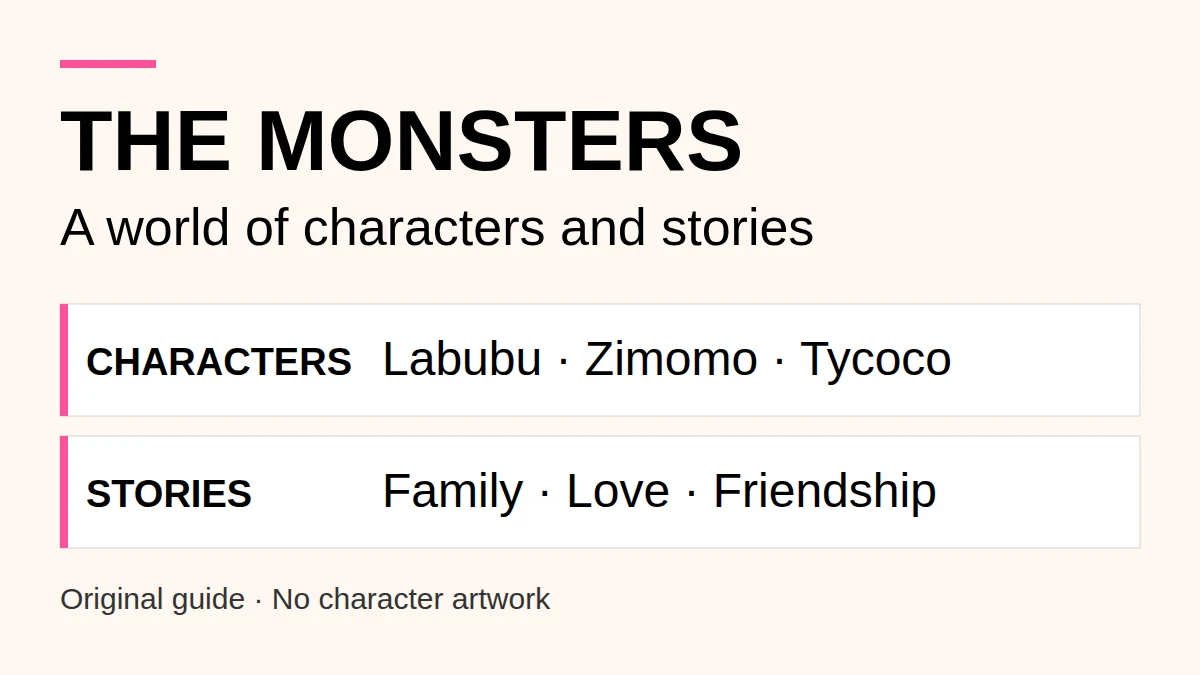
The Monsters: Labubu, Zimomo and Kasing Lung’s Cast
A sourced, unofficial guide to The Monsters: character names, Labubu and Zimomo, Tycoco’s relationship and the picture-book world.
Mixing up a character name and a collection label can leave a caption naming the wrong creature. The Monsters is Kasing Lung’s wider story and character world; Labubu belongs within it, alongside characters including Zimomo and Tycoco.
If you are trying to understand “The Monsters Labubu,” start by separating the world, the character and the product title. POP MART’s official character introduction connects the cast to Lung’s picture books; an interview with the artist confirms Zimomo’s role, and the publisher’s synopsis explains the trilogy’s themes. This independent guide brings those sources together in a character table and relationship diagrams. It covers names and story context, rather than a complete product catalogue, shopping advice or authentication.
- The Monsters: the wider collection of characters and stories.
- Labubu: a central character name, also used for a group of forest elves in the official description.
- Zimomo: the leader of Labubu’s tribe, according to Lung’s own interview.
- The books: separate stories whose themes include family, love and friendship.
Our Labubu overview provides the broader introduction. The About page explains this site’s independent, unofficial status.
Separate the world, the character and the product
The words on a box can identify different things. The Monsters names the wider creative collection; Labubu or Zimomo identifies a character; a release title identifies a particular product series. Keeping those fields separate lets you describe an object without making every name under The Monsters another name for Labubu.
Scroll horizontally if columns extend beyond the table.
| Label | What it identifies | Where to look next |
|---|---|---|
| The Monsters | Lung’s wider cast and stories | The character reference below |
| Labubu, Zimomo or Tycoco | A character name within that world | The source supporting that character’s role |
| A named product series | A particular release under the collection | Our formats and series guide |
| The Monsters Trilogy | A collection of picture-book narratives | Our books and bibliography guide |
The official character introduction names The Story of Puca, Pato and the Girl and Miró’s Requiem as the trilogy’s independent narratives. A shared cast does not make a product roster a retelling of a book.
For example, the names in our Big Into Energy reference belong to a particular pendant roster. They serve a different purpose from the cast names in this article.
Common mistake: Treating every name on a product card as a new member of the fictional cast. Check whether it is a character name, a series title or a design label.
Takeaway: Write the character and the release in separate fields when recording a collectible.
A character list with a source for each name
The table is a reference list, not a claim to catalogue every inhabitant of Lung’s world. POP MART’s official anniversary gallery supplies the names below through its paired design labels. Where an artist statement or official introduction also explains a role, that evidence appears separately; a name in a gallery alone is not a biography.
Scroll horizontally if columns extend beyond the table.
| Character | What the reviewed sources establish | Evidence |
|---|---|---|
| Labubu | A forest elf described as curious, playful and kind-hearted | Official character introduction |
| Zimomo | Leader of Labubu’s tribe; Lung describes the character as larger than Labubu | Artist interview; gallery label LABUBU&ZIMOMO |
| Tycoco | Appears in the official account of a couple with Labubu Freckles | Official character introduction; gallery label LABUBU&TYCOCO |
| Spooky | A named character in the gallery | Official gallery, LABUBU&SPOOKY |
| Pato | A gallery name also used in the second story’s title | Official gallery, LABUBU&PATO; trilogy introduction |
| Mokoko | A named character in the gallery | Official gallery, LABUBU&MOKOKO |
| Yaya | Lung says the name shares his daughter’s nickname | Artist interview; gallery label LABUBU&YAYA |
| Pippo | A named character in the gallery | Official gallery, LABUBU&PIPPO |
| Puca | A gallery name also used in the first story’s title | Official gallery, LABUBU&PUCA; trilogy introduction |
| Cowawa | A named character in the gallery | Official gallery, LABUBU&COWAWA |
The gallery belongs to the THE MONSTERS 10th Anniversary Series Figures listing, a commercial source. Its pairings label designs; they do not establish a family tree.
For Spooky, Mokoko, Pippo and Cowawa, use a creator or publisher account before treating a detailed story role as established. The gallery names above are the collection labels those listings already print.
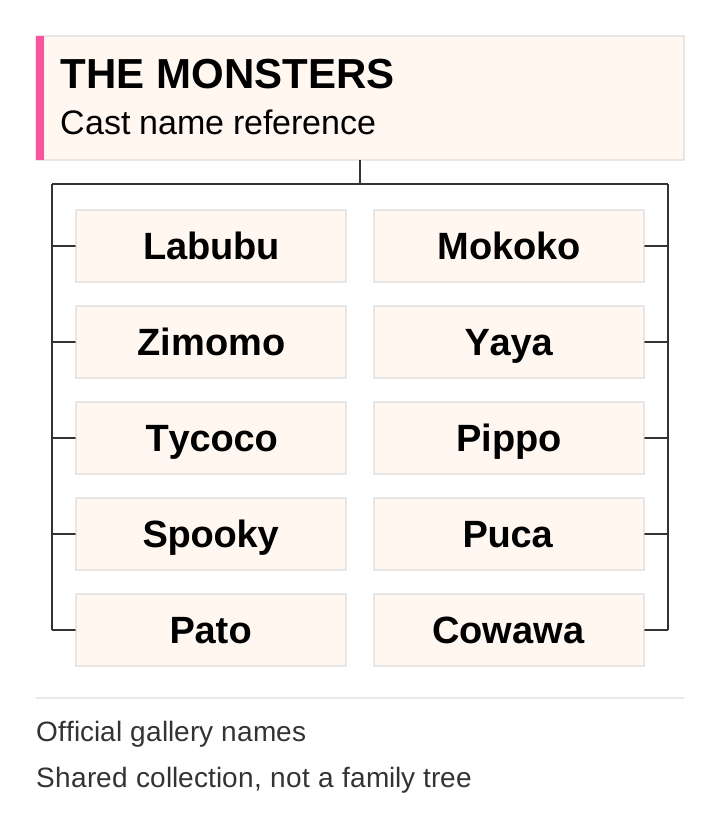
Takeaway: Keep the source for a name separate from the source for a character’s personality or relationships.
Labubu and Zimomo have different identities
Zimomo is not simply a release name for a larger Labubu. In his Hypebeast interview, Lung identifies Zimomo as the tribe’s leader and describes the character as larger than Labubu. That is an explanation of character design and role, not a size specification for every object bearing either name.
Scroll horizontally if columns extend beyond the table.
| Comparison | Labubu | Zimomo |
|---|---|---|
| Name in the cast | Labubu | Zimomo |
| Role described by the source | Forest elf; the official introduction also uses Labubu for the elf group | Leader of Labubu’s tribe |
| Source of that description | POP MART’s character introduction | Lung’s direct interview answer |
| What to record for an object | Character name plus full product title | Character name plus full product title |
The official ZIMOMO Warm Sweater listing gives another concrete reference for Zimomo. For a caption, start with the labelled character and retain the product title. Do not identify an unfamiliar object solely because it looks bigger than another one in a photograph.
Character scale and manufactured size answer different questions. Our Labubu format guide deals with product dimensions, while the origin story follows the creative history. Neither turns one product’s dimensions into a universal rule for identifying the cast.
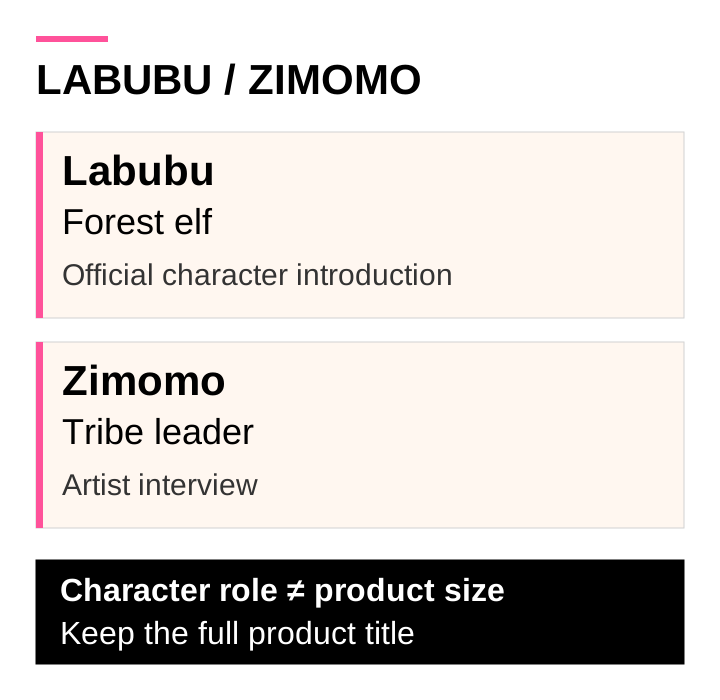
Takeaway: Use the name and its source to establish identity before comparing product size.
Tycoco’s relationship is described with Labubu Freckles
The official introduction provides a more specific relationship than a generic “Monsters family” label. Its Labubu Freckles passage describes a freckled member of the Labubu elves meeting Tycoco, followed by life as a couple. We retain that wording’s scope rather than assigning the same relationship to every elf in the group.
In that account, the relationship is romantic. It is not evidence that Tycoco is Zimomo’s partner, that all the cast members are related, or that a paired product establishes a couple.
The official character text supports the connection in the diagram: Freckles sits within the elf group, and the labelled couple connection runs specifically to Tycoco.
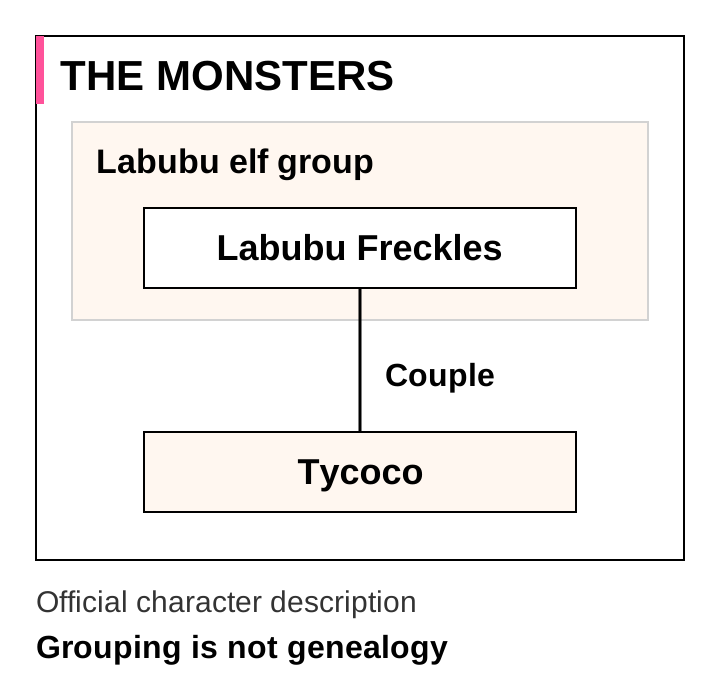
Takeaway: Label a relationship with the exact characters and the kind of connection the source describes.
The picture-book world has stories beyond the toy names
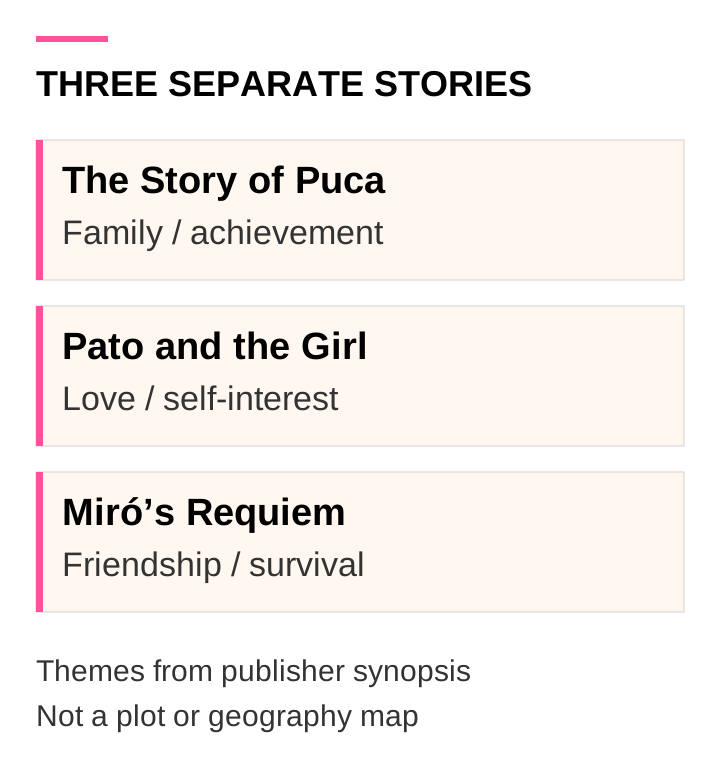
The trilogy offers story context, not a catalogue of product variants. Joint Publishing’s synopsis presents separate moral choices involving family, love and friendship. Its description also names the world THE MONSTERLAND in the accompanying map information. Our diagram is a theme guide, not a reproduction of that map or a reconstruction of its geography.
Scroll horizontally if columns extend beyond the table.
| Story title | Theme in the publisher’s synopsis | Reading question |
|---|---|---|
| The Story of Puca / 神秘的布卡 | Family and achievement | What might someone give up for a life-changing opportunity? |
| Pato and the Girl / 柏度與少女 | Love and self-interest | Is the choice about another person’s happiness or possession? |
| Miró’s Requiem / 米羅安魂曲 | Friendship and survival | What happens when loyalty and self-preservation conflict? |
These are brief English paraphrases of the publisher’s description, with English titles checked against the official character introduction. They introduce the books’ themes without reconstructing their plots.
Use the works and bibliography page for publication information. Use the artist biography for Lung’s career.
Common mistake: Reading a product roster as the plot of a book. A design label can confirm a name while leaving the character’s actions in the story unexplained.
Takeaway: A product gallery identifies names; a publisher synopsis explains themes; the book itself supplies the detailed narrative.
When this does not apply
This reference helps with names and sourced story context. It does not settle every question about an object or the fictional world. Use a different source for product authenticity, rights ownership or edition availability.
- For product forms and series terminology, read the types guide.
- For one pendant roster and its design names, read the Big Into Energy guide.
- For detailed character actions, consult the relevant book rather than inferring a plot from a gallery.
- For this site’s remit, including its lack of authentication services, read the site FAQ.
Takeaway: Match the question to its evidence before reusing a character chart.
Frequently asked questions
Are the monsters and Labubu the same?
Labubu belongs within The Monsters. For a caption, “The Monsters / Labubu / [release title]” keeps the wider collection, character and object distinct. The official introduction also uses Labubu as a group name, so avoid turning every mention into a single individual.
Is the monster Labubu rare?
A character name does not identify one edition or establish its availability. This page has no edition-level dataset for measuring rarity. Use a specific release record if that is your question; do not infer scarcity from a character’s position in this list.
Are the monsters authentic Labubu?
The Monsters is a real collection name in the official sources, but a name on packaging does not establish that an individual object is genuine. The diagrams here explain characters. They are not authentication tests, and this site does not examine or certify items.
What is the story behind the monster Labubu?
There are two reading tasks: the artist’s creative history and the fictional stories. Our origin story covers the former. For the latter, start with the trilogy titles and publisher’s themes above, then read the books for narrative details rather than treating merchandise names as plot summaries.
What age group are Labubu for?
Check the particular product or book. The Canadian anniversary figures listing used for the name table says it is unsuitable for people under 15. That product-specific notice does not establish an age recommendation for every Labubu release or for the trilogy’s reading audience.
Is Labubu good or evil?
POP MART’s official introduction describes Labubu as playful and kind-hearted. The publisher’s themes concern moral choices, rather than assigning a good-or-evil rating to the whole cast. Use those descriptions as story context; appearance alone does not supply a character’s motivation.
Method and sources
This guide was checked on October 8, 2026, using public sources and AI-assisted drafting with source review. It is a compilation and explanation, not hands-on product examination or a claim to have checked every page of every edition.
The official introductions and gallery are commercial sources. The interview supplies the artist’s own answers. The publisher supplies story synopses. The Monsters Wiki was consulted for cross-checking and source leads; accessible material and search-index excerpts were not used to fill unsupported biographies. Some wiki pages could not be read directly.
For a reusable note, record world, character, stated relationship, source and date checked. For an object, add its full release title in a separate field. Leave an unsupported relationship blank rather than copying it from a paired design label.
All five illustrations are original text and abstract relationship diagrams. They depict no copyrighted character artwork and reproduce no product photographs. The question wording comes from the October 6, 2026 US-English search snapshots for “the monsters labubu” and “labubu”; the search results establish reader questions, not their answers.
- POP MART: LABUBU character introduction, THE MONSTERS, LABUBU and LABUBU FRECKLES passages; official commercial source.
- Hypebeast: A Conversation With Kasing Lung at His “EVERYBODY KNOWS” Exhibition, March 2024; original artist interview, particularly the answers about favourite characters.
- POP MART Canada: THE MONSTERS 10th Anniversary Series Figures, design labels and product-specific age notice; official commercial source.
- Joint Publishing: The Monsters Trilogy / 精靈三部曲, publisher synopsis and THE MONSTERLAND map description.
- POP MART US: ZIMOMO Warm Sweater Figure, Zimomo product reference; official commercial source.
Related reading:
- Labubu overview — Start with the character and its broader public history.
- Kasing Lung’s works — Find the book titles and publication references.
- Labubu types and formats — Separate character names from manufactured formats.